

How To Set Snare Traps

How can companies make more than a billion dollars selling a service that almost no one wants? Past signing upward millions of members who don't know that they're condign members.
A survey by credit card company Visa estimates that nearly 3 in ten Americans accept been stung by a subscription trap. Here'south how information technology works: Y'all purchase airline tickets or flowers or a digital camera at a site like Orbitz, The states Airways, or FTD–and just when yous think y'all've completed your transaction, you get an offer for cash dorsum or free shipping. So you lot click the button, and a screen appears asking for your electronic mail address in exchange for that attractive little benefit. It seems like a small price to pay, so yous comply and then finish your purchase.
3 months after, as yous review your credit bill of fare statement, you discover that you've been dunned for $fifty in membership dues by some company you've never heard of, for a club that yous never knew you belonged to and that you've never received any benefit from. (Even when the offer promises something similar cash back or free shipping, those promises often apply to your next purchase, non the one you but completed).
Unfortunately, getting your money back isn't easy. According to some angry consumers, getting a total refund required writing a letter (the old fashion way) and waiting months to receive a credit card chargeback.
Welcome to the world of posttransaction marketing, a billion-dollar industry that most people have never heard of. (For a slideshow presentation of posttransaction marketing in action, see "How Subscription Clubs Bring in Members.")
In 2009, the U.South. Senate Commerce, Scientific discipline and Transportation Committee, headed by Jay Rockefeller (D-Due west Virginia), began an investigation of the manufacture (the investigation is ongoing). Co-ordinate to the committee, the three biggest players in this business organization, Affinion Grouping, Vertrue, and Webloyalty–all based in Norwalk, Connecticut–have earned (at a bourgeois estimate) $1.iv billion in revenue over the past 10 years. They shared more than half of that money with their hundreds of Website partners, including such widely respected companies as Avon, Barnes & Noble, Upkeep, Purchase.com, Classmates.com, GMAC Mortgage, MovieTickets.com, Priceline, Shutterfly, Staples, and Ticketmaster.
In return for their cut of the activity, these large-proper name companies commonly laissez passer consumers' credit card information to the posttransaction marketing firm–unbeknownst to many of the affected consumers. At one site, all you have to do to trigger the handoff is to type your electronic mail address: Even if you never click a Submit push or press Enter on your keyboard, your billing data goes flying from 1 company to another.

Inside the posttransaction marketing business, such an exchange is called a data pass. Though some consumers consider it a betrayal of their trust, it is certainly lucrative. The Senate Commerce Committee's interim report (PDF) lists Comcast, Orbitz.com, and Priceline.com (which operates Fandango) among 19 retailers that have fabricated more than than $x million each from partnerships with the iii marketing businesses over the by x years. One merchant, United Online, the parent company of Classmates.com, has earned $70 million via Affinion, Vertrue, and Webloyalty, co-ordinate to Senate investigators. Shutterfly has made $6 million over by 10 years from these partnerships, the report says.
Convenient or Disruptive?
Many observers believe posttransaction marketing is a business model built on deception.
David Murray, a Massachusetts hospital executive, inadvertently enrolled in Affinion's $12-a-calendar month LiveWell health-related membership program when he made a purchase at ane-800Flowers. He concedes he erred by clicking on a '$15 Cash Back' push, but he insists that the offer was presented in a "deceitful" manner.
"The gild confirmation stated 'Your purchase is consummate. Click here to claim $xv.00 Cash Back on this purchase!' This is not true. 1-800Flowers isn't offering $15 back, LiveWell is. And who the hell is LiveWell?" Murray says.
Murray complains that the data-pass procedure obscured the fact that he was actually making a separate new purchase of a LiveWell membership. "I accept an old maxim: 'It may be legal, but is it moral?' Well, I don't think it'due south legal. And I know it wasn't moral. Is this really something 1-800Flowers wanted to be associated with?"
Apparently not. Company spokesperson, Joseph Pititto, says, "We reviewed the programs and notified the partner we are not renewing our contract." He says that fewer than 2 percentage of customers complained to ane-800Flowers almost Affinion membership programs.
Senator Rockefeller is among the most outspoken critics of posttransaction marketing. "These companies use aggressive sales tactics intentionally designed to mislead online shoppers," he says. His committee'due south investigation has put the industry'south Big Three firms under a microscope.
"There are more than 4 million American consumers whose credit cards are being charged by mysterious membership clubs afterwards shopping online, and most of these 4 1000000 consumers don't even know it'southward happening," Rockefeller claims.
Officials for Affinion, Vertrue, and Webloyalty all bristle at the charge that they mislead customers. In the past, each has claimed that its offers are clear and their details are conspicuous. Their policy of obtaining your credit carte data from a merchant that you lot only finished doing business organisation with isn't sneaky, they debate: Information technology's a convenience to you.
Affinion, which runs more than than two dozen membership programs including Buyers Advantage, Travelers Advantage, and Identity Secure, did not respond direct to Rockefeller'south comments, but company spokesperson James Hart says, "Affinion is proud of its long-standing history of employing the all-time marketing practices in the industry…our programs provide tremendous value for millions of consumers worldwide." According to Hart, Affinion's marketing terms are explicit and require consumers to give "informed consent" before they join one of the visitor'southward membership programs.
Online marketing expert Ben Edelman, an assistant professor at Harvard Business Schoolhouse who testified at the Senate Commerce Committee hearing terminal yr, believes that posttransaction marketing uses "allurement and switch" sales techniques and is deliberately deceptive.
"Most consumers have no idea they're even enrolled in these programs or how a 3rd party got concord of their credit carte du jour number," Edelman says.
Making It Clearer
In January, in response to the Senate Commerce Commission'southward investigation, Affinion, Vertrue, and Webloyalty agreed to modify their online offering pages. Instead of collecting credit card information directly from the host Website where the offering appears, the companies at present crave consumers to enter their 16-digit credit carte information a 2d time to establish a membership (and to receive whatever special greenbacks-back or rebate offer).
Since Webloyalty began requiring consumers to input their credit carte numbers a second time, the company has seen a drop in enrollments, spokesperson Beth Kitchener says, though she declines to specify how big the drib has been. "If there is defoliation nearly how people enroll in our programs, we are happy to address those concerns," Kitchener says. "Nosotros don't want customers who don't want u.s.a.."
Rockefeller says that requiring consumers to input their credit card numbers twice is a "pace in the right direction," only he still views the companies' offers equally misleading and is pushing for further changes in their business organisation practices. Moreover, because the 3 companies adopted the change voluntarily, other firms that engage in posttransaction marketing need non follow their lead.
Seeing for Ourselves
During a shopping excursion at Spiegel.com, I discovered how piece of cake information technology is to mistakenly sign up for a membership program. After I made my purchase and progressed to the order summary page, a window offer "free shipping" popped up. Looking closely, I realized that that the offer didn't apply to my current purchase; instead, it was expert for my next purchase at Spiegel.com and came "Compliments of Spiegel Privilege Pass." I clicked 'Keep' and found myself on a Web folio that stated prominently at the elevation "Claim your Free Shipping Certificate Now!"
At the bottom was a text field instructing me to enter an electronic mail address as an "electronic signature" agreeing to "activate your privilege pass membership." In the lower left-hand corner of the browser was a greyness box with text that in several browsers appeared slightly blurry spelling out the "Offer Details." The details explained that "activating your membership" meant like-minded to pay a $i.95 "activation fee"; furthermore, if I didn't cancel my membership within 30 days, the club would begin debiting my credit carte at a rate of $fourteen.95 per calendar month.
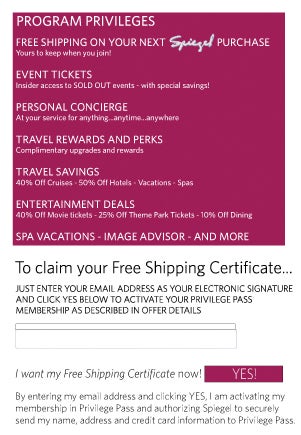
What happened adjacent surprised me. I typed my electronic mail address in the text field–but earlier I clicked anything else or pressed Enter on my keyboard, the Web form seemed to register my email address automatically and jumped me to a page welcoming me to Privilege Pass. This page said that within 24 hours, I would receive a confirmation e-post, a "Aircraft Certificate," and a user ID and Password to admission my Privilege Pass benefits. When the confirmation electronic mail arrived, it included no mention of fees associated with membership and no instructions on how to abolish.
Privilege Pass is a discount membership programme that offers discounts on travel- and entertainment-related purchases. The program is run by Encore Marketing International, a privately held company in Lanham, Maryland. The company did not reply to repeated electronic mail and telephone requests to be interviewed for this story.
Representatives of Signature Styles, the owner of the Spiegel brand, say that information technology has not received many complaints about the way its partner markets the Spiegel Privilege Pass. Spokesperson Parker Block says that Signature Styles is currently in discussions with Encore Marketing International to update the fashion Spiegel's Spider web site enrolls consumers in the Privilege Pass monthly subscription membership. "We are developing a ways to exist more transparent to consumers to brand their feel more satisfying to government, consumer advocacy groups, and consumers," Block said. The company volition change the process in the near future, he said.
Some Partners Cut Ties
The vast bulk of retail Websites I interviewed that piece of work with Affinion, Vertrue, and Webloyalty say that they piece of work hard to build a positive relationship with customers and don't desire to tarnish it through deceptive practices. Simply since the Senate Commerce Committee investigation began, only 8 of the estimated 450 companies that partner with the Big Iii–Air Tran Airways, Continental Airlines, Fandango, Intelius, ane-800Flowers.com, Priceline.com, U.s. Airways, and Vistaprint–have publicly appear that they will no longer let companies to brand misleading pitches during the checkout process on their Websites.

Both 1-800Flowers and US Airways say that they won't be renewing their contracts with Webloyalty. Priceline and Vistaprints say that they will no longer work with Affinion. Intelius says that it no longer works with Vertrue.
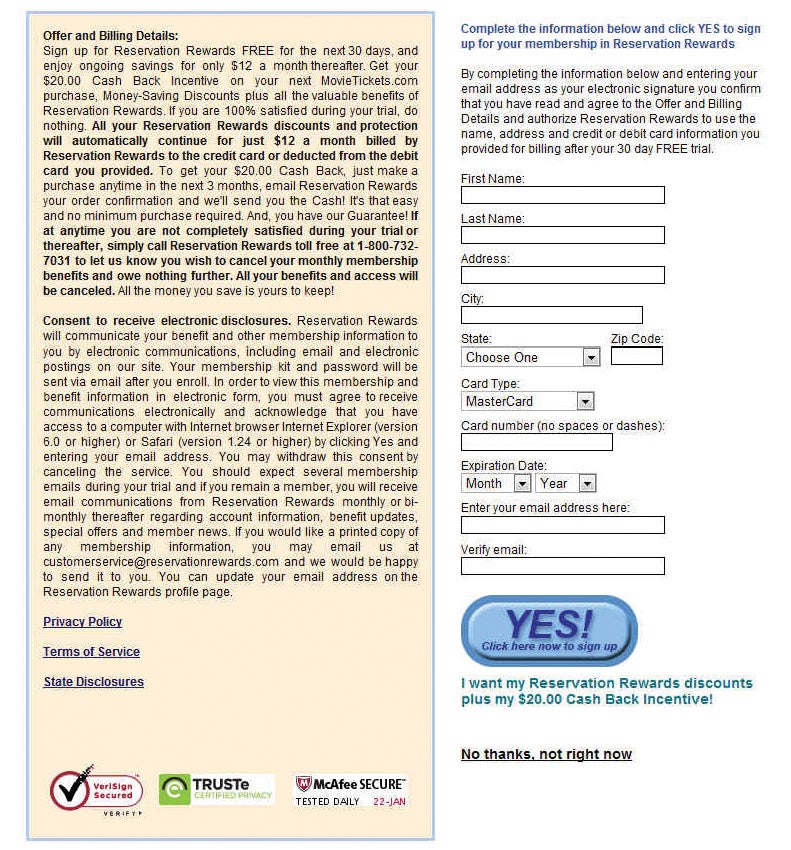
Both Allposters.com and MovieTickets.com go along to offer pitches for club memberships on their sites. MovieTickets.com dangles a "$twenty cash dorsum incentive" in exchange for trying Webloyalty'south Reservation Rewards programme (which offers dining and travel discounts). AllPosters.com plays upwards a $xv coupon in commutation for trying membership in Webloyalty'southward Shopper Discount and Rewards guild. Both sites enquire you lot to enter your credit card information a second fourth dimension to acknowledge that you are joining a club, and both explicitly warn that you'll be charged if you don't cancel your membership within 30 days.
Money-Become-Round
Spokespeople for a number of companies told me that they don't believe posttransaction marketing confuses or entraps their customers, merely Rockefeller says that the results of his committee's investigation show otherwise. "The interviews and the e-mail service communications provide abundant evidence that the east-commerce partners are aware that their customers are being misled by the enrollment offers from Affinion, Vertrue, and Webloyalty," the committee's report states.
Even more scathing is a study that the Senate investigation unearthed from Webloyalty as role of a amendment for information. According to internal visitor documents, Webloyalty surveyed 243 of its Reservation Rewards members and found that 76 percent of them either didn't remember being offered a Reservation Reward membership or said that they had declined a membership offer. The survey was conducted earlier Webloyalty began asking customers to enter their credit card data a 2nd time to sign upwardly for its programs.
The commerce committee written report also included an electronic mail bulletin in which a Vertrue employee estimated that "counterfoil calls represent approximately 98 per cent of call book" to the company'south customer service center.
A review by the Improve Business Bureau of numerous complaints confronting these companies indicates that many consumers charged for society membership said they were unaware they had given these companies their billing information.
Financial information that the companies provided to the Senate Commerce Commission reveals that the Large Three (Affinion, Vertrue, and Webloyalty) and their e-commerce partners accept generated more than than $1.4 billion in revenue over the by 10 years from Cyberspace consumers who take been charged for membership programs. Of the $1.4 billion in total revenue, $792 million went to the eastward-commerce retailers.
My review of the posttransaction marketing companies' financial information indicates that their revenues may have been considerably higher. For example, Webloyalty reported revenue of $193 million in 2007 lone, according to the virtually contempo numbers available; and in that same yr, Vertrue announced that it was projecting revenue of $800 million. For its part, for the third quarter of 2009, Affinion reported in backlog of $184 1000000 in revenue from its Membership Products segment. Those numbers suggest that combined revenue for the 3 firms may now exist shut to $1 billion a year.
No Strangers to Courtrooms
Rockefeller isn't the but politician to have gone after Affinion, Vertrue, and Webloyalty. Affinion has been sued by the attorneys general of 16 states interim in concert, and by the attorney full general of Florida (PDF) separately. In 2008, the company paid $25 meg to settle a nationwide course-action lawsuit for allegedly billing and collecting unauthorized charges from consumers for products or memberships that consumers never requested or consented to receive. (Some of those incidents dated back to years earlier 2005, when Affinion was known every bit Trilegiant.)
Webloyalty is currently under investigation past the attorney general of Connecticut. In 2009, Webloyalty agreed to settle a class-activeness lawsuit in which plaintiffs declared that the company had defrauded them. As part of the settlement Webloyalty agreed to adopt a number of changes to the fashion it markets its loyalty programs, besides equally to pay $ten million to consumers who had inadvertently signed up for its membership clubs.
Over the by nine years, Vertrue, which changed its name from MemberWorks in October 2004, has been sued by the attorneys general of California, Florida, and Iowa. Each suit involved similar allegations that the company had deliberately misled customers or charged them without their knowledge.
In January, New York attorney general Andrew Cuomo issued subpoenas to 22 e-commerce retailers–Avon.com, Barnes & Noble, Budget, Buy.com, Classmates.com, Columbia House, Expedia/Hotels.com, FTD.com, Gamestop/EB Games, GMAC Mortgage, Hotwire.com, Intelius, MovieTickets.com, 1-800Flowers.com, Orbitz.com, Pizza Hut, Priceline.com, Shutterfly.com, Staples.com, Ticketmaster.com, Travelocity, and Vistaprint–seeking information on their dealings with Affinion, Vertrue, and Webloyalty. Cuomo says that these "well-known companies are tricking customers into accepting offers from 3rd-political party vendors, which then siphon money from consumers' accounts."
Who Has Your Back?
Some people, including Senate investigators, believe that the government shouldn't be the only entity looking out for consumers' interests in these cases. They think that credit bill of fare companies American Express, MasterCard, and Visa should do a amend job of policing posttransaction marketing.
The argument goes like this: The credit card companies undoubtedly receive many requests from customers to reverse charges from Affinion, Vertrue, Webloyalty, and similar companies. (Each company declined to discuss how many times they accept received chargeback requests from customers disputing a accuse from them.) Credit card companies accept rules for dealing with merchants whose customers oft inquire to have their charges reversed. Offending merchants are subject to fines or even removal from a credit card'south network.
In the wake of the Senate Commerce Committee's initial study, American Express spokesperson Lisa Anselmo says that her company is scrutinizing the way Websites laissez passer credit card information to Affinion, Vertrue, and Webloyalty. "We share the committee's concern and are investigating alleged unfair and deceptive practices," Anselmo said. "A merchant can't just transfer data to a tertiary party."
MasterCard declined a request for an interview, instead releasing this statement: "We are investigating online marketing practices by sure merchants. As part of this investigation, we have notified the banks that provide acceptance services for these merchants that they must take activeness against merchants violating MasterCard rules."
Visa officials refused to comment specifically about Affinion, Vertrue, and Webloyalty, across saying that the visitor is cooperating with the Senate Commerce Commission's investigation. A Visa spokesperson says that the visitor has a zero tolerance for fraud. If consumers feel that they were tricked into a accuse, they should request a chargeback and Visa will investigate, the spokesperson said.
How to Avoid Getting Hooked
You lot'd think that not joining a order would be the easiest thing in the earth. But at many sites, consumers regularly become sucked into signing up for discount shopping clubs that they accept no interest in joining. Here's what to look out for:
* When you lot encounter words such every bit "complimentary," "cash back," and "rebate" on a Web site, warning bells should ring in your head–no thing how credible the site. Take a deep jiff before clicking to take advantage of whatever such deal, and read all of the terms and weather condition carefully. Too frequently, accepting a "greenbacks back" offer turns into a plush mistake.
* If the terms and conditions are confusing, the company may take cached something in them that information technology doesn't want you lot to find. Skip information technology!
* When completing a purchase online, expect for prechecked boxes that may bind y'all to terms and conditions you don't desire. Uncheck those boxes.
* Don't store online with your depository financial institution debit card. Credit card companies such as American Limited, MasterCard, and Visa are protected nether the federal Fair Credit Billing Human activity. When you dispute a charge on your credit card, yous tin enquire your credit carte company to withhold payment while it investigates. You don't have the same protections with a debit menu purchase.
How to Quit a Club You Never Meant to Join (and Get Your Coin Back)
Hundreds of large-name Web sites offering shoppers discounts or costless shipping if they'll join a disbelieve order that charges a monthly membership fee. Joining these clubs is and then piece of cake that many people don't even know they've washed it. Getting out of the guild–and getting your money dorsum–is the hard part.
Hither are the almost constructive steps to take to become your money back from what are known as posttransaction marketers.
one. Call the billing visitor. First contact the company that is directly billing you–not the Web site that presented the original offer. Be polite, ask to cancel your membership and demand your money dorsum. If the representative refuses to refund your coin or claims to be unable to, ask to talk with a managing director. Note the date and time of your telephone call and the names of all the service representatives you speak with. Getting nowhere? Inform the company yous are going to dispute the charge with your credit bill of fare company.
two. Call your credit card visitor. American Limited, MasterCard, and Visa offer their credit card customers fraud protection and will investigate claims of bogus billing. Order a formal claim with your credit carte du jour visitor, explaining that a posttransaction marketer billed you for a service that you lot mistakenly signed upward for or were non aware you had requested. Emphasize that you've tried to get your money back from the billing company with no success.
Thanks to a high-contour Senate Commerce Committee investigation, companies that engage in posttransaction marketing are currently under a microscope, and credit card companies say that they are willing to investigate and opposite these charges.
Spider web Shopper: $ten Back Led to $45 Gone

Eating house.com'southward slogan is "eat, potable, save money," merely don't tell that to Bellingham, Washington, resident Kari Glennon. She thinks the site'south motto should be "eat, drink, and watch out for surprise charges on your credit card bill."
Glennon's problems began in Oct 2008, when she bought several Restaurant.com gift certificates for her coworkers. The next month she noticed a mysterious $14.95 charge on her Visa credit card statement for "Shopping Essentials." Glennon shares the account with her married man and assumed that the accuse was his. Iii months later, she realized that she'd now been charged the aforementioned amount three months in a row, so she decided to investigate.
Glennon called a price-free phone number that she plant online for Shopping Essentials and discovered that it was a shopping society owned past Norwalk, Connecticut-based Vertrue; the club offers discounts on section store gift cards and charges members $14.95 a month for belonging to it.
"I told the woman on the phone I had no recollection of joining the service," Glennon said. The rep told her that the charges originated from her Restaurant.com buy. "But how did y'all get my credit carte number?" she asked. The representative told her that Eating place.com had given the credit carte data to Vertrue after she had clicked on a "$10 greenbacks dorsum" imprint ad and input her email address.
"I don't recollect clicking on anything, and I did non give my credit menu information to Restaurant.com for the purpose of signing up for a membership," Glennon says. "I felt taken advantage of."
Millions of unsuspecting online shoppers have had experiences similar to Glennon's, co-ordinate to investigators examining like marketing offers at hundreds of mainstream Websites.
Sharing credit card information betwixt companies may be controversial, just it's nevertheless perfectly legal–for now. However, the business organisation of posttransaction marketing has caught the attention of the U.S. Senate Committee on Commerce, Science and Transportation, which launched a probe last twelvemonth to decide whether this type of marketing should be banned. [Hither is a long (2 hours, fifteen minutes) video of the committee's hearing on "Aggressive Sales Tactics on the Internet and Their Impact on American Consumers ."]
Thousands of consumers have complained to the Better Business Bureau, saying that they, similar Glennon, inadvertantly became members of a Vertrue service despite having no memory of signing up for it.
In response to the Senate committee'south investigation, Vertrue earlier this year voluntarily modified its marketing offers so that prospective club members must now input their credit bill of fare number a 2d fourth dimension to confirm that they want the membership.
Restaurant.com spokesperson Tony Bombacino says that his visitor cut ties with Vertrue in November 2009 later the Senate committee began investigating the business practices of major posttransaction marketers Affinion, Vertrue, and Webloyalty. "We felt it would exist best to end our relationship and find out what the Senate investigation ended," Bombacino said.
Eatery.com has an A+ rating with the BBB, according to Bombacino. He likewise says the number of complaints that his company received from customers well-nigh its relationship with Vertrue was low. Vertrue has an F rating with the BBB because of a "failure to honor commitment to intervene or mediate disputes," according to the BBB.
When Glennon asked Vertrue for a refund, its representatives told her that they could credit only the well-nigh recent charge back to her Visa account. If she wanted the outstanding $29.90, they told her, she would have to mail the request to Vertrue'south postal address, and the refund might accept upwards to six weeks to arrive. She says that she received it 3 weeks later. Representatives at Vertrue declined to comment on Glennon's feel, but they say that the company has always allowed members to abolish an account and receive a refund over the phone.
"I got my coin back," Glennon says. "But what about all the [Shopping Essential] customers who are still paying $fourteen.95 a calendar month for a service they don't even know they signed up for?"
Vertrue says that it is cooperating with the Senate committee investigation and making changes to its business.
Notation: When you purchase something later clicking links in our articles, we may earn a small committee. Read our affiliate link policy for more details.
Source: https://www.pcworld.com/article/516763/mystery_subscriptions_anger_web_shoppers.html
0 Response to "How To Set Snare Traps"
Post a Comment